We cut a 30-day product down to one interview
Coach 30-Day began as a system to take a new coach to a first paying client in a month. In about three weeks, research, a review board and a written decision record narrowed it to one private voice conversation that records what an expert knows and how sure it is.
- 30-day launch system1 to 7 September
- Two offer options8 September
- One interview14 September onward
- Role
- Research, product, design and engineering
- Platform
- Desktop-first web app, private and invite-only
- Stack
- Next.js, React, Supabase, OpenAI realtime voice over WebRTC
- Timeline
- Idea on 1 September 2026, current build merged by 18 September 2026
- Review board
- Survived, narrowly. 20 objections raised, none left unresolved
- Status
- In progress. Built and tested, not yet hosted or evaluated
Three framings in three weeks
The product kept the name Coach 30-Day while it changed shape. It is now called Expert Model V1.
- 1 to 7 September 2026
First-Client Launch System
One voice interview, then a 30-day loop of offer, outreach and buyer evidence, ending at a first paid coaching engagement.
- 8 September 2026
V1 voice-interview prototype
One 45-minute interview produces two offer options, and the coach picks one to test for 30 days.
- 14 September 2026 onward
Expert Model V1
One private voice conversation that records what an expert knows, then stops before any commercial strategy.
The problem
Plenty of people know their field well enough to help someone, and still cannot turn that into a focused market, a credible offer or a first paying client.
The original plan was to fix all of that in 30 days. The research argued against it. The first market scan found the 30-day, done-for-you launch promise already taken, by offers like a $197 done-for-you launch and a 12-week accelerator. Courses and marketplaces show the steps and leave a novice to assemble them. General AI tools can summarise a conversation, but they do not reliably separate what the expert actually said from market guesses and the model's own inference.
That pointed to a smaller, sharper problem. An expert's know-how is often stronger than their ability to put it into words and carry it into later strategy work. Anything built on top of that record, from an offer to a brand, needs to know which parts came from the expert and which were guessed.
The solution
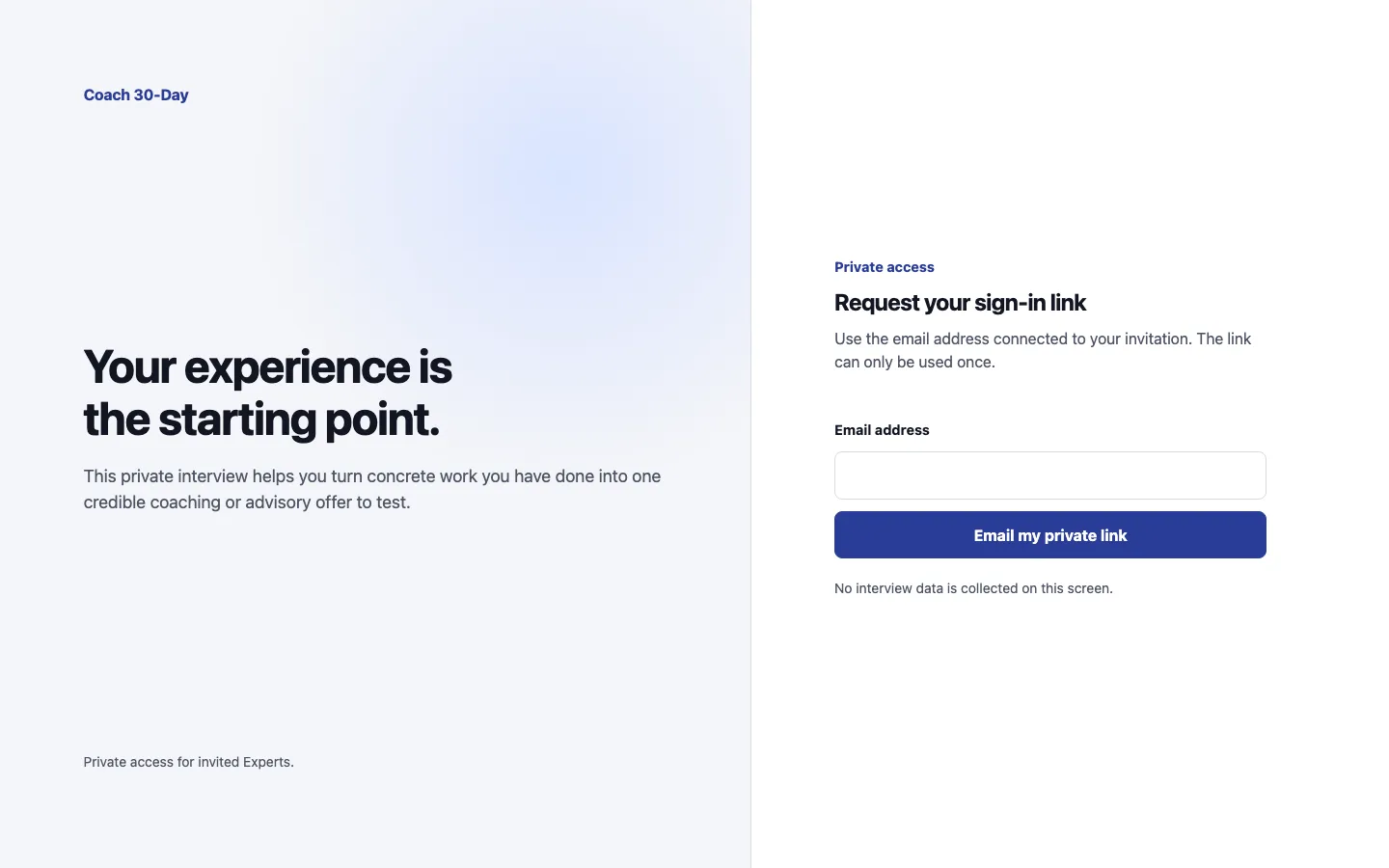
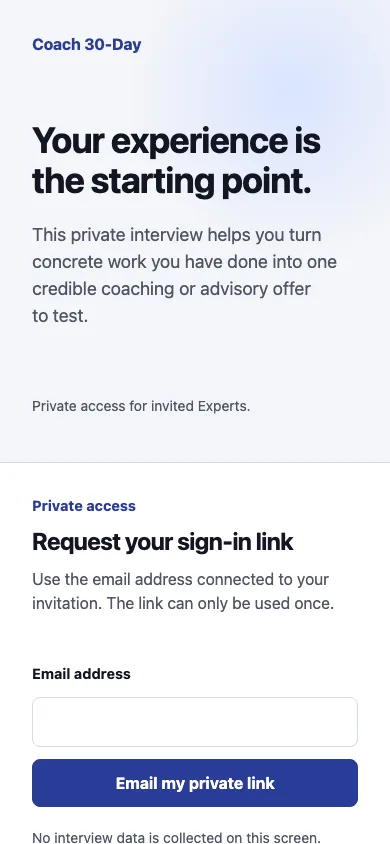
Expert Model V1 is one private conversation, up to 45 minutes, with an AI voice guide. An expert is invited by email, signs in with a one-time link, and accepts a consent screen before the microphone is ever requested. That screen says plainly what happens: text is kept, OpenAI processes the transcript, no audio is stored, and this is not therapy. The guide opens by admitting it is still learning to listen and asks to be corrected, then asks about one concrete time someone relied on the expert's judgment.
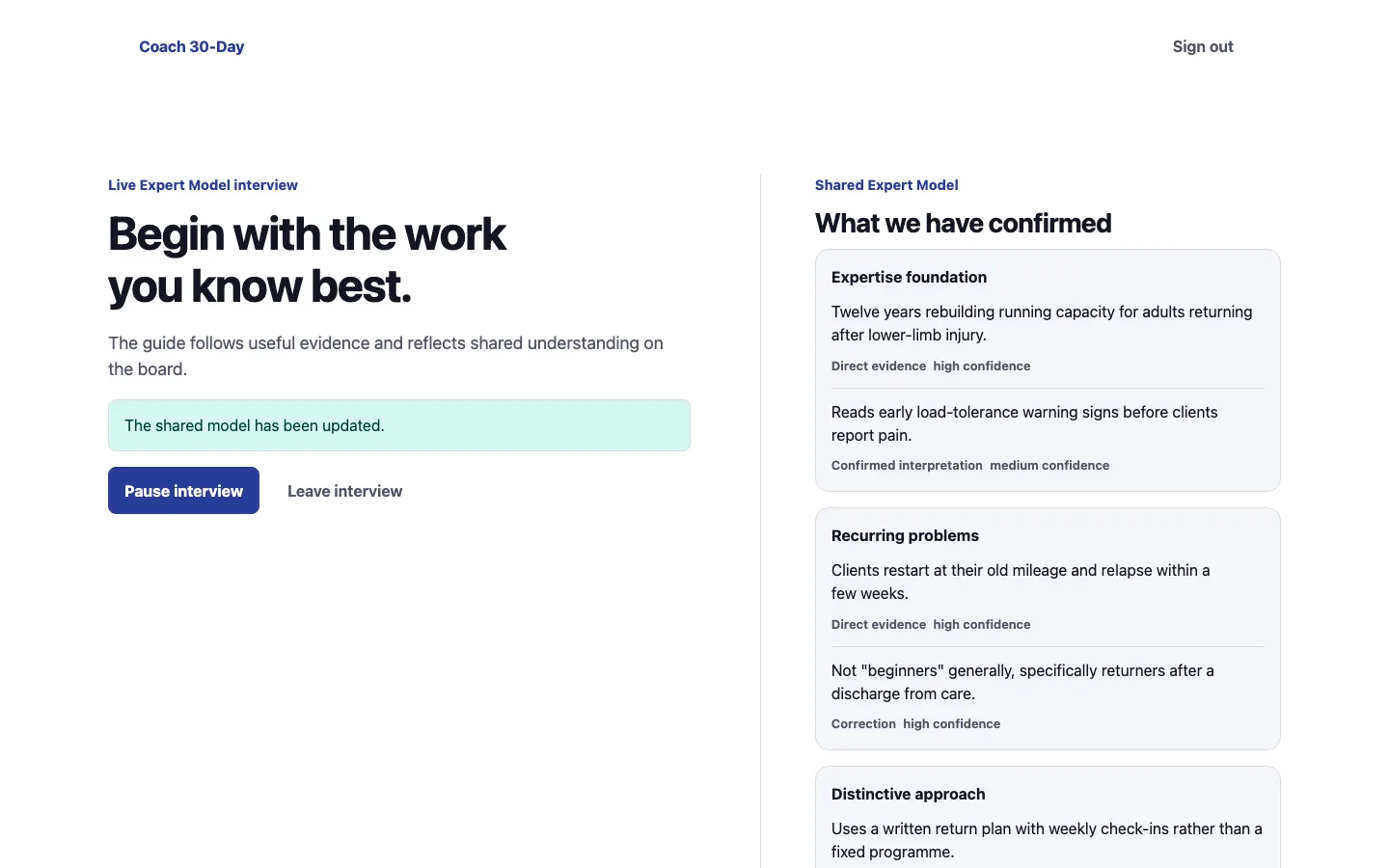
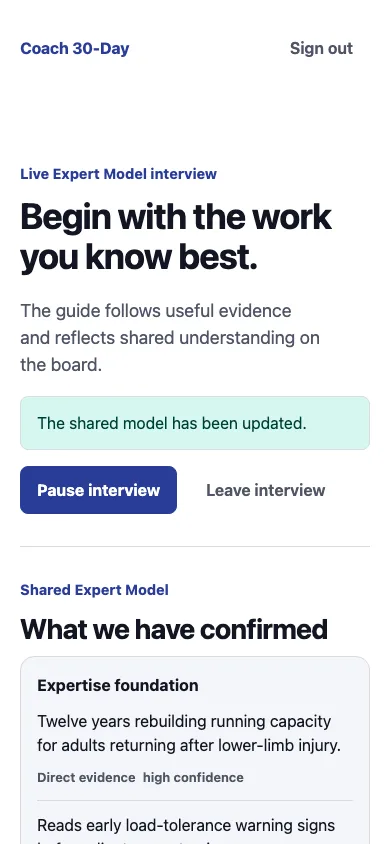
Beside the conversation, a second model maintains a structured board. Each claim is labelled as direct evidence, a market hypothesis, an interpretation, a correction or needing validation, with a confidence level and references back to the transcript. The board has six fixed sections, visited in whatever order the conversation needs. Once all six are confirmed, the expert asks for a spoken recap, makes final corrections and confirms the record. Offers, pricing and brand are left to people, working by hand afterwards.
Feature highlights
- Consent before the microphone.
The consent screen asks for no microphone access and starts nothing until the expert ticks and accepts.
- Evidence labels on every claim.
Claims without transcript references or confirmation are rejected before they reach the board.
- Corrections by voice.
Experts fix the record by speaking, and each correction is kept as a claim, not written over.
- Pick up where you left off.
An interrupted interview reconnects from the confirmed record without repeating the opening.
- A hard stop on the server.
Sessions end at 45 minutes, enforced by a server job that runs every minute, not the browser timer.
The thinking
Seven decisions from the dated record. Turn a card to read why.
What we cut
The 30-day loop of daily prospect suggestions, review blocks and checkpoints.
Designed, never built.Any AI output on offers, pricing, ideal customer profiles, brand or go-to-market.
The $300 launch price, the $150 monthly fee, the refund guarantee and the five-seat pre-sale.
Prospecting, content and payments.
Speed, done-for-you delivery and vertical focus as selling points.
The review board judged them table stakes.Vanity metrics: waitlist size, interviews completed, assets generated and post-interview NPS.
Raw audio, and with it, replay.
A draggable, sticky-note canvas for the board.
Each cut is in the dated decision record, with its reason.
One head, six thought cards, each marked with how we know it
The two board images are static reconstructions with a fictional expert, not captures of a live session. There is no video, on purpose.
What's next
The interview flow is built and tested but not yet hosted or evaluated.
Next come the expert's summary download, operator exports, and a first read of the validation bets written before the build.
Got a big idea that needs cutting down? Talk to us.
kyle@sindstudios.com
Kyle reads every message.
 Next thought · Poetry in MotionA membership video studio for one teacherRead it